
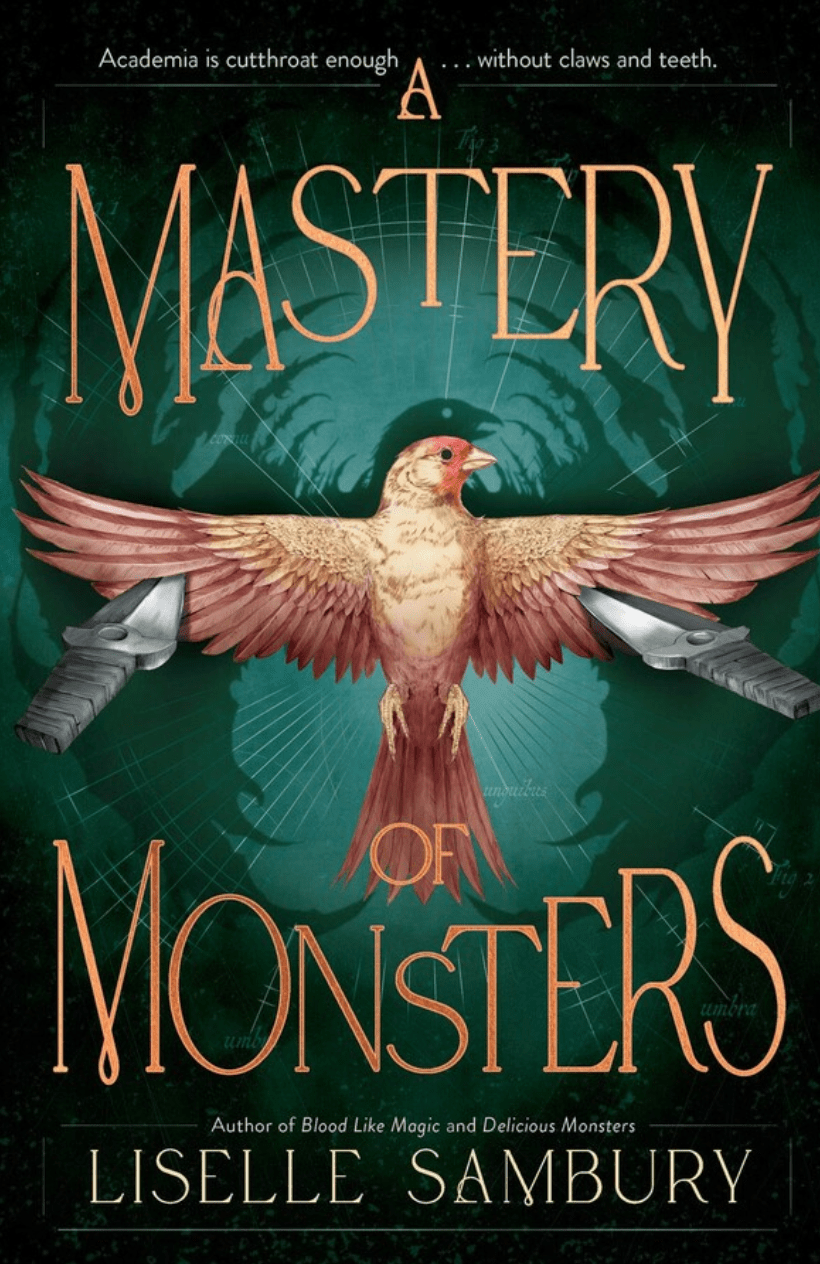
A thrilling urban fantasy that masterfully blends supernatural elements with themes of family, identity, and institutional inequality – Available July 29th from Simon & Schuster (ARC Review)
Most of us know that secret societies in fiction often hide dark truths beneath their prestigious facades. Originally designed for prestige, they frequently become mechanisms of control and oppression. Liselle Sambury deftly explores this concept in her new novel: A Mastery of Monsters. This urban fantasy is written by the author of the acclaimed Blood Like Magic duology, and Sambury once again proves her talent for weaving together supernatural elements with powerful social commentary.
As A Mastery of Monsters opens, we follow August, a fierce and determined young woman whose brother Jules has disappeared before his sophomore semester at Queens University in Toronto. Everyone assumes he left due to the stress of college, but August knows better – especially since their mother recently went missing as well. The only clue Jules left behind was a cryptic note telling August to stay safe and protect what remains of their family.
August’s search for answers takes a shocking turn when she’s attacked by a ten-foot-tall creature with fur and claws. This encounter leads her to Virgil Hawthorne, a bookish young man who knows about these monsters because he is one. Virgil makes August a proposition: join the Learner’s Society and partner with him, and in return, he’ll help her find her brother. The deal is appealing to August for a significant reason – she’s convinced the Society is somehow connected to her brother’s disappearance.
In fact, the connections run deeper than she initially realizes. August is thrust into a deadly competition to win one of the few coveted candidate spots in the Society, where she learns that monsters are human beings with a mutation that causes them to transform into violent creatures. Masters like August can help monsters retain their humanity by forming a special bond with them. This partnership is August’s only hope of finding her brother, and Virgil’s only chance at avoiding imprisonment or worse.
The political landscape of the Society becomes even more complicated when the Doctorate (the leader of the society and the only person who can control any monster without bonding) dies unexpectedly. For the first time in Society history, an election is held to determine the new leader. The former Doctorate had three children: Carrigan, who seems to want a cure for “monsterism”; Adam, who claims to want better treatment for monsters; and James who wants the Society to stay just as it is.
As an outsider paired with Virgil – whose parents revolted against the Society when he was a child – August faces hostility from most of the Master candidates. When she’s unfairly disqualified in the final trial, she decides to work with another organization: the Queens Black Student Society (QBSS). What appears on the surface to be just a cultural campus organization is actually a rival group working in opposition to the Learner’s Society, founded by descendants of one of the original Society founders who believed its purpose had become corrupted.
Through QBSS, August makes a shocking discovery – her missing brother Jules is one of the monsters attacking QBBS members. Further investigation reveals that one of Virgil’s mentors, Ben, has been secretly bonding with multiple monsters, including August’s brother, to further his own agenda against the Society. This revelation leads to a climactic confrontation where August, Virgil, and their allies uncover the truth and fight for their survival.
Sambury’s world-building is exceptional, creating a rich mythology that feels authentic and lived-in. The Learner’s Society is divided into factions that mirror real-world political divisions: Progressives seeking equality for monsters, Traditionalists wanting to maintain the status quo, and Scientists searching for a “cure.” Despite the Society’s claims of equality, monsters are clearly treated as “others,” creating a powerful metaphor for systemic inequality.
The relationship between August and Virgil provides the emotional heart of the story. Their forbidden attraction (relationships between Masters and monsters are prohibited) develops naturally amid the danger and mystery. Virgil’s gentle, academic nature balances August’s fiery determination, creating a partnership that feels both authentic and compelling.
The novel ends with several tantalizing revelations: August successfully bonds with Virgil (discovering a rare ability in the process); Jules’s new Master is Nina, the leader of the Progressive faction; and most shockingly, August learns a secret Jules had been hiding the entire time.
For fans of Tracy Deonn’s Legendborn, A Mastery of Monsters offers a similar exploration of a Black protagonist entering a secretive society entrenched in prejudice while battling supernatural threats. Both novels deftly use fantasy elements to examine institutional racism and the legacy of white supremacy, but each maintains its unique voice and worldbuilding.
The characters are diverse and fully realized, from Cory, who lost fingers and a leg in a failed attempt to partner with her monster brother, to Margot and Isaac, who become August’s allies in navigating the complex politics of the Society. Each character feels distinct and three-dimensional, contributing to the rich tapestry of this world.
A Mastery of Monsters might not be for everyone, but I would encourage fantasy readers to visit your local bookstore on July 29th when it releases. The novel is a perfect blend of action, mystery, and social commentary, shining a telling light on how institutions can perpetuate inequality while claiming to protect humanity. Sambury has created a world that’s impossible not to get lost in, with enough loose threads to leave readers eagerly anticipating the sequel.
A Mastery of Monsters will be available from Simon & Schuster on July 29th, 2025.
★★★★★ (5/5 stars)
 Page, Screen & Beyond
Leave a comment