
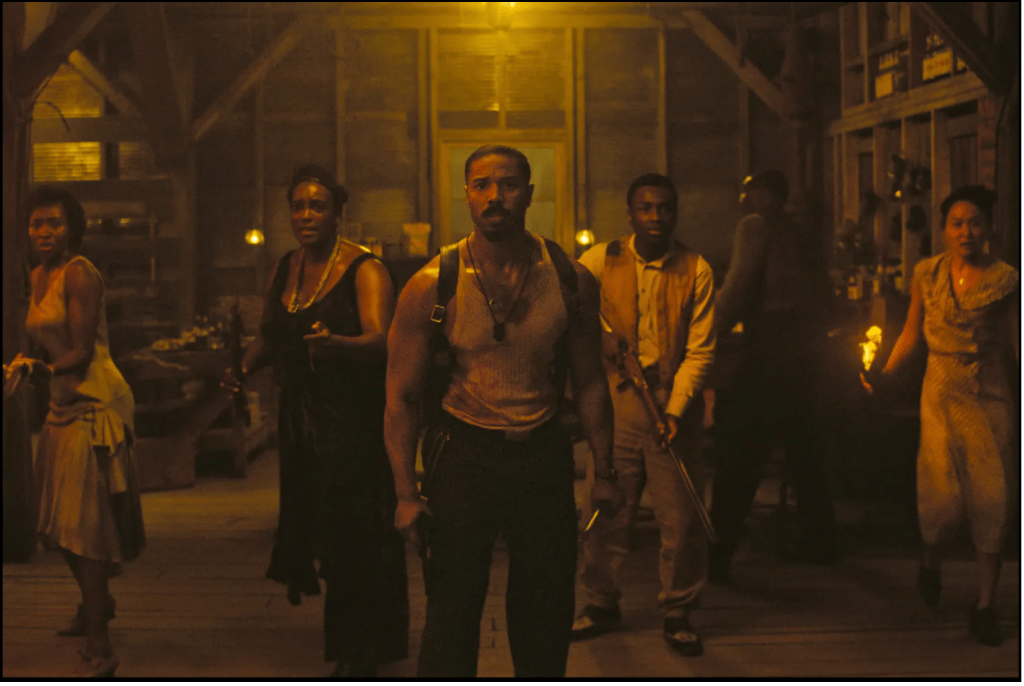
If you’re anything like me, you’ve been craving a film that doesn’t just entertain but moves you, that respects your intelligence while delivering visceral thrills, and Ryan Coogler’s Sinners delivers all of that and then some. This is not just a vampire movie, though it is gloriously, unapologetically that. This is a meditation on freedom, on heritage, on what we carry with us when we flee our pasts and what awaits when we dare to return home.
At the heart of this stunning film is Michael B. Jordan, and honey, let me tell you—this man is doing the work. Playing dual roles as the Smokestack twins, Smoke and Stack, Jordan gives us two fully realized performances that are so distinct, so specific, that you genuinely forget it’s the same actor. Smoke is all quiet intensity and barely contained grief, a man who’s been holding the weight of the world on his shoulders for so long he’s forgotten what it feels like to put it down. Stack is looser, more impulsive, carrying his pain differently but no less deeply. The way Jordan navigates between these two brothers, the subtle shifts in posture and voice and energy, is nothing short of masterful. Every frame he’s in crackles with purpose.
And can we talk about Miles Caton as Sammie Moore? In his feature film debut, Caton absolutely demolished this role. Sammie is the film’s spiritual center, a young musician whose blues guitar doesn’t just entertain—it conjures, it heals, it connects past and future. When Sammie plays, you feel it in your bones. Caton brings such raw vulnerability and power to the character that by the time we reach that incredible musical sequence in the juke joint, where his playing literally summons ancestors, I was in tears. This young man has a brilliant career ahead of him, mark my words.
But the true revelation, the performance that absolutely wrecked me in the best possible way, is Wunmi Mosaku as Annie. Lord have mercy. Annie is a hoodoo practitioner, a healer, a woman who owns her power and her softness in equal measure. She’s Smoke’s former partner, the mother of a child they lost, and she carries that grief with such dignity and grace while never letting it define her. Mosaku plays Annie as a woman who is deeply connected—to her traditions, to her community, to the spiritual world, to her own heart. The scenes between Annie and Smoke are some of the most tender, most honest depictions of Black love I’ve seen on screen in years. There’s a scene at Annie’s shop where they confront their shared past, and Mosaku and Jordan are so present, so vulnerable, so real that I forgot I was watching actors. When Annie calls Smoke by his given name, Elijah throughout the film, each utterance is a stripping away of armor, a return to truth for Smoke.
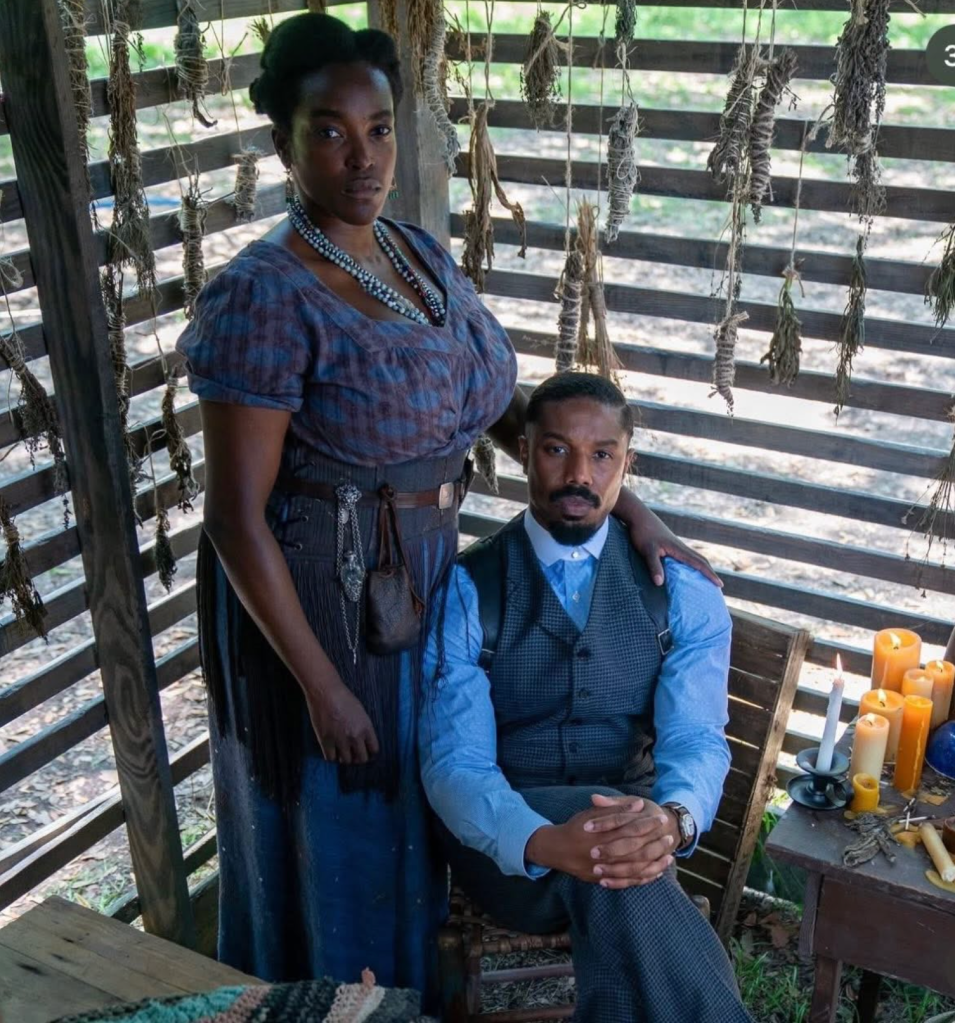
What makes Annie’s character so powerful is that she’s allowed to be everything—sensual, spiritual, strong, soft, angry, forgiving. She’s a full-figured, dark-skinned Black woman at the center of a love story, treated with reverence and desire and respect. In an industry that so often marginalizes women who look like her, Coogler wrote Annie with such care, such love, and Mosaku brought her to life with such artistry that audiences have been calling her the soul of the film. And they’re right. Annie is a protector of culture, of tradition and of love itself. Mosaku’s performance is nuanced and layered, finding moments of lightness and humor even in the midst of profound grief. The way she moves through the world of the film, grounded and spiritually attuned, makes every scene she’s in feel sacred.
Now, as for Mary—I have to be honest here. Hailee Steinfeld gives a committed performance, and the character herself is fascinating in concept. Mary is a white-passing mixed-race woman navigating the treacherous waters of Jim Crow Mississippi, caught between worlds, in love with Stack but unable to be with him because of the violence that interracial relationships invited. The exploration of colorism and passing is important, and Steinfeld clearly did her homework, connecting with her own family history to bring authenticity to the role. But—and here’s where I get a little conflicted—Mary as a character didn’t fully work for me. Perhaps it’s because the film has so much richness elsewhere that Mary’s arc, particularly once she becomes a vampire, feels slightly underdeveloped compared to the depth given to Annie, Sammie, and the twins. She serves an important function in the plot, and her final fate is intriguing, but I found myself wishing for more interiority, more of a window into what drives her beyond her relationship with Stack.
That’s not a knock on Steinfeld’s performance, which is perfectly fine—she brings fire and vulnerability to the role, especially in her more provocative scenes. But in a film overflowing with such profound characterization elsewhere, Mary sometimes feels more like an idea than a fully realized person. The relationship between Mary and Stack has heat, but it doesn’t have the same emotional weight as what we see between Smoke and Annie. Perhaps that’s intentional—a commentary on the difference between desire and true partnership—but it left me wanting more.
What’s undeniable is that Sinners is a technical marvel. Coogler shot this in 65mm IMAX, and every frame is gorgeous, dripping with atmosphere. The production design is exquisite, immersing you completely in 1932 Mississippi Delta—from the juke joint that becomes the film’s main battleground to Annie’s herb shop filled with roots and remedies to the oppressive beauty of the landscape itself. Ludwig Göransson’s score is phenomenal, weaving together blues, jazz, and something altogether otherworldly. The music in this film is more than a backing piece, it’s just as much character as the actors, it tells the history of the Delta, and it speaks of resistance. When Sammie plays, when Delta Slim (a pitch-perfect Delroy Lindo) wails on his harmonica, you understand that this is music so powerful it can pierce the veil between life and death, past and future.
The vampire mythology in Sinners is stripped back to basics in the most effective way. These aren’t your sparkly romantics or your tortured antiheroes. These are predators, pure and simple, Irish immigrants who have their own complicated relationship with otherness and oppression but who have chosen to feed on the Black community they encounter. The parallels Coogler draws—between vampirism and cultural appropriation, between the undead and those who profit off Black culture while draining it of life—are bold and brilliant. The film asks hard questions about exploitation, about who gets to take and who is left empty, about the cost of survival in a world built on hierarchies of power.
The horror elements are genuinely effective. Coogler knows how to build tension, and when the violence comes, it’s brutal and visceral. The practical effects are stunning—real blood, real prosthetics, real stakes (pun absolutely intended). There’s a sequence in the juke joint where all hell breaks loose that had my entire theater gasping and clutching their seats. But what makes Sinners more than just a great horror movie is that Coogler never loses sight of the humanity at its core. Even in the midst of supernatural chaos, this remains a story about people trying to break generational curses, trying to build something better, trying to love in a world that wants to destroy them.
The ensemble cast is uniformly excellent. Jayme Lawson as Pearline brings warmth and wisdom. Li Jun Li as Grace Chow has a fantastic moment of maternal fury that showcases the protective instinct of mothers across cultures. Jack O’Connell is appropriately menacing as Remmick, the lead vampire, playing him with just enough charisma to make you understand why someone might invite him in before realizing the danger. And Delroy Lindo, as always, is a treasure—his Delta Slim is weathered and world-weary but still has enough spark left to fight when it matters.
Sinners is Ryan Coogler’s most ambitious film to date, and it’s clear this is deeply personal work. The reverence he shows for Black Southern culture, for the blues as a living tradition, for the complexity of Black life in Jim Crow America, is evident in every frame. He doesn’t shy away from the horror of that era—the constant threat of violence, the economic exploitation, the ways white supremacy constrained every aspect of Black existence. But he also refuses to make this a story solely about suffering. There’s joy here, sensuality, music, community, love. The residents of this Mississippi Delta town support each other, protect each other, celebrate each other. The juke joint isn’t just a bar—it’s a space of freedom, where people can be fully themselves, if only for a night.
I’ve seen Sinners twice now, and it gets richer with each viewing. There are layers upon layers of symbolism and meaning woven throughout. The imagery of water and drowning. The significance of names and naming. The way light and shadow play across faces. The choice to have certain key moments happen in doorways and thresholds. This is a film that rewards close attention and repeat viewings.
Is it perfect? No. The pacing in the middle section occasionally feels stretched, and as I mentioned, Mary’s character arc doesn’t quite achieve the depth of the others. There are moments where Coogler’s ambition slightly exceeds his grasp, where he’s trying to say so many things at once that a few threads don’t fully resolve. But honestly? I’d rather watch a film that swings for the fences and occasionally misses than one that plays it safe. And Sinners is swinging for the damn stars.
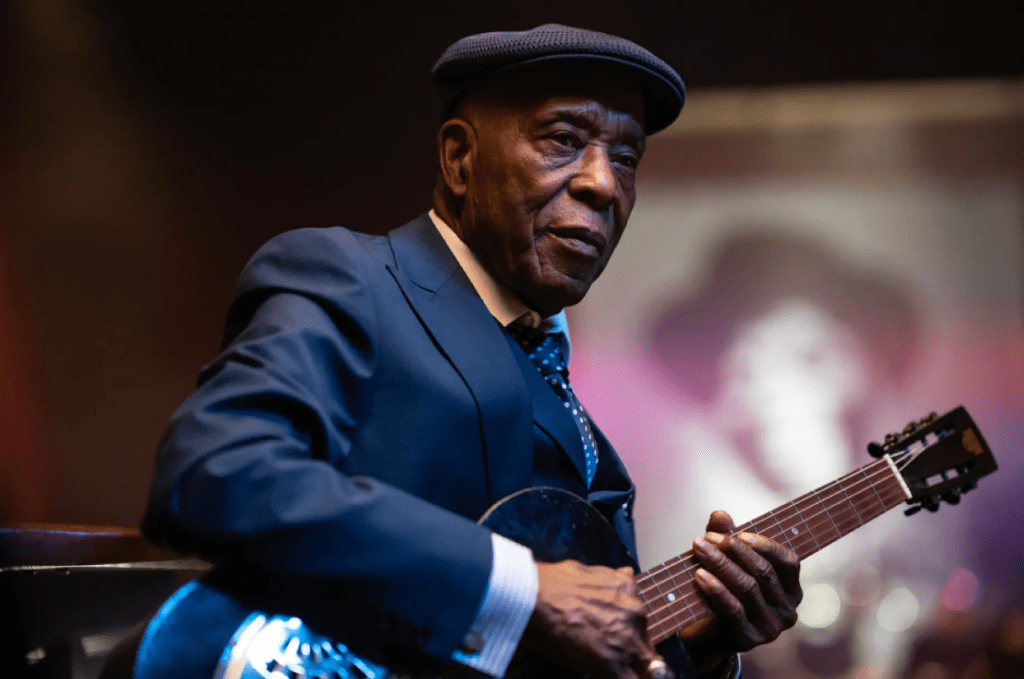
The ending—without spoiling anything—is haunting and beautiful and leaves you with so much to think about. The post-credits sequence, featuring blues legend Buddy Guy, brings the film’s themes full circle in a way that’s both satisfying and thought-provoking. It asks us to consider what survives, what endures, what we pass on.
In a year that’s given us some truly exceptional films, Sinners stands out as something special. It’s horror, yes, but it’s also romance, tragedy, musical, social commentary, and love letter to Black Southern culture. It’s proof that genre filmmaking can be artful and meaningful without sacrificing entertainment value. It’s a showcase for some of the best performances of the year, particularly from Michael B. Jordan, Miles Caton, and especially Wunmi Mosaku, whose Annie deserves to be in every awards conversation.
This is the kind of film that reminds you why you fell in love with movies in the first place. It’s bold, it’s beautiful, it’s bloody, and it has so much to say. Ryan Coogler has crafted something truly original here, a film that honors the traditions it draws from while pushing the genre in exciting new directions. The fact that this exists, that a major studio gave Coogler the resources to make this vision a reality, feels like a small miracle in our current IP-obsessed landscape.
Sinners is messy and ambitious and deeply felt. It’s a film about the past that speaks urgently to the present. It’s about the stories we tell ourselves about who we are and where we come from. It’s about the music that sustains us and the love that redeems us. It’s about what we’re willing to sacrifice and what we refuse to give up.
See it on the biggest screen you can find. Let Ludwig Göransson’s score wash over you. Let Miles Caton’s guitar pierce your soul. Let Wunmi Mosaku’s Annie teach you what strength looks like. Let Michael B. Jordan remind you that he’s one of the finest actors working today. And let Ryan Coogler show you that there’s still magic in cinema, still stories worth telling, still new ways to make you feel something true.
This is one for the ages, y’all. Don’t miss it.
 Page, Screen & Beyond
Leave a comment